What Is Quantum Computing and Why Do Tech Innovators Seek a Quantum Advantage?

On 6 December 2023, Airbus and the BMW Group gave a clear indication on how they view the importance of Quantum computing.
The global giants of the mobility industry launched: “The Quantum Mobility Quest”, a competition explicitly designed to bring quantum technologies out of the lab and turn them into real-world applications.
Framed as “bringing together two global industry leaders to harness Quantum technologies for real-world industrial applications,” the challenge invited students, quantum computing researchers, startups and professionals worldwide to tackle big questions around aerodynamics, sustainable materials, supply‐chain optimisation, and autonomous mobility scenarios.
The underlying premise was this: classical computing is starting to hit a wall and it’s time for innovators to explore new pathways that Quantum may open.
Then in 2024, Airbus and BMW Group unveiled the winners. Across five categories, Quantum Simulation, Quantum Solvers, Quantum-Powered Logistics, Quantum Machine Learning, and a Golden App open category, teams from around the world demonstrated their Quantum solutions.
From Germany, a team from Hamburg University claimed a win in Quantum Solvers category by devising a method to combine classical and Quantum Computing for solving complex aerodynamic equations, the kind that determine wing shapes and airflow.
Researchers at the University of Southern California won the Quantum Simulation prize for modelling how materials behave at the atomic level. Elsewhere, the Golden App prize went to TU Delft. Their entry tackled how carbon-fibre layers are stacked in aircraft and car components.
The collaboration by Airbus and BMW’s Quantum Computing for Materials and Design initiative was a small but symbolic step into a new computing era. Quantum technology, once confined to theoretical physics, is now desirable as an emerging tool of industry. Many major companies are seeking a Quantum advantage.
Quantum Computing Explained Briefly
To paraphrase Richard Feynman, the father of Quantum simulation: if you think you understand Quantum, you don’t understand Quantum at all.
And yet, despite its renowned complexity, Quantum technology can be broadly understood as this: a way of exploiting the quirks of physics and Quantum mechanics at the smallest scales.
Where classical computers process information as classical bits (ones and zeros) quantum machines use Quantum bits, or qubits: particles such as electrons or photons that can exist in multiple Quantum states at once, a property known as superposition. Link those individual qubits through entanglement, and changes to one instantly affect the others, no matter how far apart they are.
Quantum computers are able to operate on multiple so-called “basis states” at the same time, in contrast to the “sequential” processing by classical computers.
Some Quantum systems rely on superconducting circuits cooled to near absolute zero; others trap ions or guide photons through optical networks, all seeking greater stability against decoherence, the tendency of fragile Quantum states to collapse.
Overall, it could mean that future quantum computers are able to simulate new materials, optimize global supply chains, or speed up the modelling of complex molecules in ways that would defeat the fastest classical supercomputer.
In fact in October 2025, Google claimed just that. According to the researchers, their Quantum-processor chip, “Willow”, has achieved a Quantum advantage. Google’s so-called Quantum Echoes algorithm reportedly reached an estimated 13,000× speed-up over the world’s fastest classical supercomputer for a physics simulation task.
The potential growth of quantum computing power is not actually linear but exponential. Instead of having to double the number of transistors on a chip (one transistor represents exactly one bit), you only need to fit one additional qubit on a Quantum chip to double the computing power, assuming perfect qubits.
There’s still quite a way to go for quantum computing to reach its full potential. But if progress is accelerating fast enough, few in the field will doubt where it’s heading.
The Bifurcation of Computing Power
For the first time in half a century, computing has split in two. On one side lies classical computing, bounded by Moore’s Law. On the other, quantum computing. We seem to be entering an age of hybrid computing, where quantum processors are starting to “plug in” to classical systems to handle specific, high-value tasks while CPUs and GPUs do the rest.
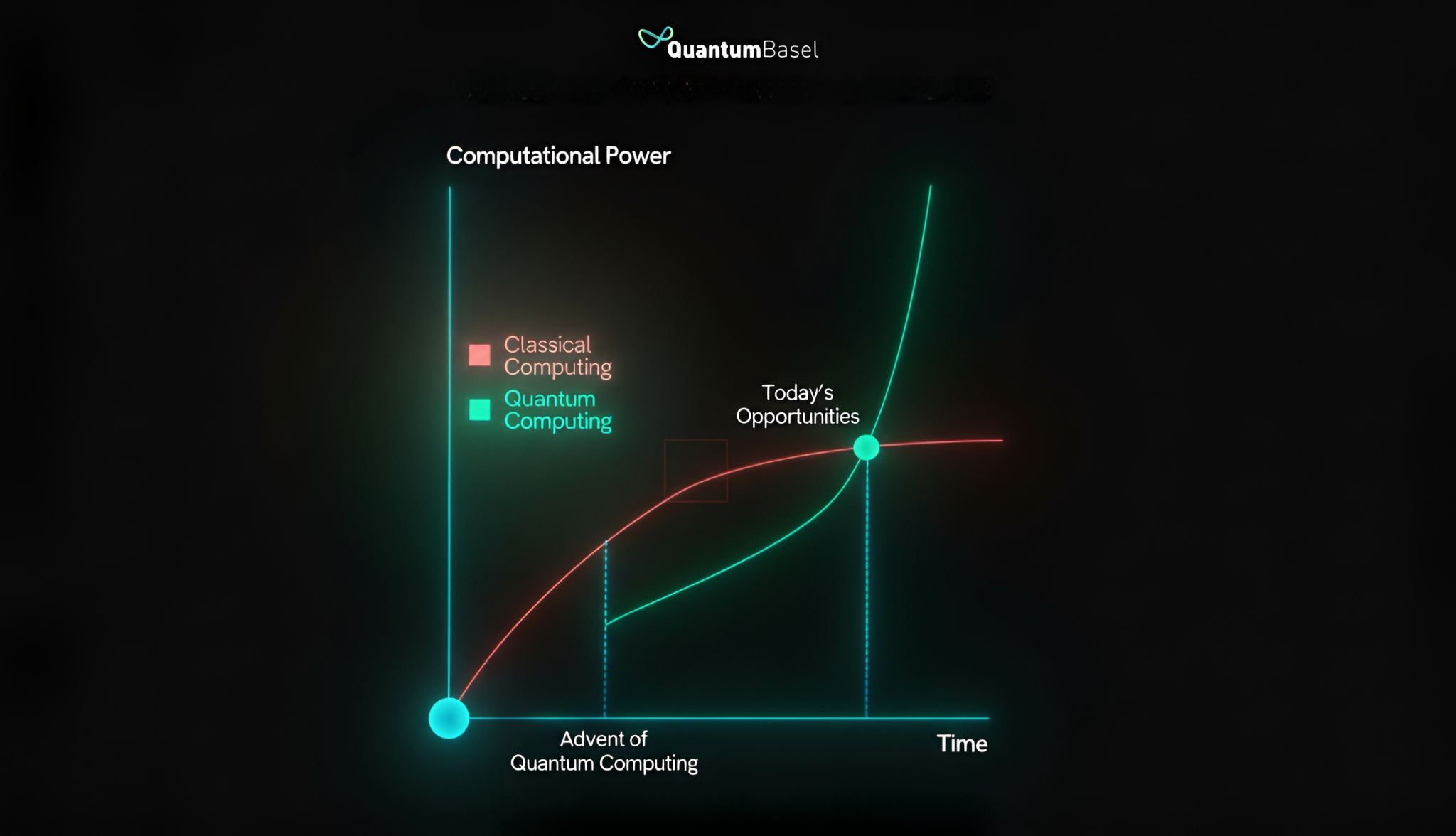
At QuantumBasel, our success stories show how hybrid computing is already bringing results - depending on the use case, a classical, a quantum, or very often a hybrid quantum-classical approach may fit best.
QuantumBasel and Moonlight AI
QuantumBasel co-developed two ML approaches to improve detection of Circulating Rare Cells (CRCs), a key cancer biomarker.
- AI optimisation: +10–15% accuracy improvement on the company’s AI with lower compute.
- AI Training complexity: 5x reduction.
- IP: An AI pipeline, which lends itself to integration with quantum methods, with two patent applications submitted.
QuantumBasel and Pfizer
With D-Wave and QuantumBasel, we piloted a hybrid solver at Pfizer’s Freiburg site to optimize complex shop-floor schedules, improving feasibility, reducing conflicts and shortening schedules compared with classical methods.
- Two-third reduction of makespan: Meaning production runs were completed faster.
- One-third fewer constraint violations: Greater schedule stability and fewer process conflicts.
- No observed machine overlaps, priority conflicts, or missed deadlines.
- Pfizer reported marked reduction in late jobs and average tardiness.
The Quantum race is well and truly on. IBM, Amazon, and Google are building hybrid Quantum architectures in the cloud. J.P. MorganChase is one of the earliest financial institutions to experiment with quantum optimization algorithms. The bank announced a Security and Resiliency Initiative, worth $1.5 trillion, to invest in areas like Quantum technology.
As Boston Consulting Group (BCG) wrote in its report, What Happens When “If” Turns to “When” in Quantum Computing: “Even if there remains a long road to the finish line, the field is hurtling toward a number of important milestones. Early movers will build the kind of lead that lasts.”
The End of Linear Progress?
For decades, the digital economy ran on the promise of Moore’s Law. Every 18–24 months, computing power doubled as engineers packed more transistors onto a chip.
That exponential curve, predictable, steady, self-reinforcing, now seems to be flattening, however. The limits of silicon are physical. Transistors can only shrink so much until they can’t anymore, and the energy required to operate modern data centres is projected to explode.
Consider this: according to The Brussels Times, ChatGPT consumes 25 times more energy per query than a Google search.
Using the Washington Post’s statistics on the daily water and energy cost of Gen-AI platforms, Business Energy UK suggests that going forward each year “the 117 lowest-consumption countries each consume less electricity than ChatGPT.”
Each new AI model is going to come with escalating computational hunger and environmental cost. AI clusters, once the hallmark of progress, are now vast warehouses of GPUs humming at megawatt scale. But Quantum computing might represent a tantalising way out of that corner.
Why Quantum Computing Matters Now
The potential value of quantum computing lies not only in its power but in its extraordinary range. What began as a thought experiment in computer science and quantum physics in the early 1980s (when scientists such as Richard Feynman and David Deutsch first imagined using quantum systems that compute) now seems to be entering the world of practical applications.
Across industries, quantum methods are starting to show some real promise:
- Finance: Quantum algorithms for portfolio optimization and risk modelling are under active testing at JPMorgan and Goldman Sachs. HSBC recently announced a trial in collaboration with IBM using quantum and classical resources together to optimize bond trading.
- Pharmaceuticals: Companies like Roche and Biogen are exploring quantum-enhanced molecular simulations to accelerate drug discovery.
- Energy: Quantum models are investigated to be used to simulate materials for batteries and carbon capture.
- Technology & Cloud Infrastructure: Microsoft, Amazon, and IBM are building cloud-based quantum platforms (Azure Quantum, Braket, and IBM Quantum), opening access to quantum hardware and software for researchers and enterprises worldwide.
- Manufacturing & Logistics: Airbus, BMW, and Hermes are experimenting with quantum systems for design optimization and routing efficiency.
Another compelling advantage of quantum computing is its potential to reduce the energy footprint of computation. One study by Oak Ridge National Laboratory found that quantum computers “could reduce energy usage by more than 20 orders of magnitude.”
Another example by Rong Fu, published in ArXiv, showed a large-scale quantum simulation achieving a much lower energy-per-task metric (0.29 kWh) compared to a classical equivalent (4.3 kWh).
According to McKinsey, the interest in Quantum could translate into a global quantum-technology market worth $97 billion by 2035, with Quantum computing alone projected to reach $72 billion.
And BCG has previously estimated that the majority of quantum’s total market value will accrue to organizations already active today. Bullish, perhaps, but that’s the nature of emerging technology curves: the winners tend to be those who move first.
Are Quantum Patents Increasing?
Patents are often the earliest sign of an industrial shift and Quantum is no exception. Patent filings are going through the roof in many countries as researchers race to make Quantum hardware and software more scalable, stable, and capable of tackling complex problems.
According to Glasgow IP law firm Murgitroyd’s Introduction to Quantum Computing and Patent Trends and IPWatchdog’s Quantum Computing Patent Landscape 2024, filings have surged across the U.S., China, Japan, and Europe.
A lot of this activity centres on breakthroughs in quantum physics, error correction, and systems based on trapped ions and superconducting qubits, all crucial for building practical, fault-tolerant machines. Researchers are also attempting new ways to stabilize qubits, reduce noise, and extend coherence times for greater commercial viability.
Amazingly, MIT’s Quantum Index Reports finds that between 2016 and 2021, Quantum Computing patent family filings went up by more than 300%, while total Quantum technology patents grew five-fold from 2014 to 2024.
China is reportedly ahead of the game and leads with 60% of patents as of 2024, followed by the United States and Japan.
Closer to home, Moonlight AI and QuantumBasel's collaboration, for instance, recently led to two patent applications.
What Top CEOs Say About Quantum Computing’s Future
The biggest names in technology are certainly rallying behind the Quantum revolution. Here’s what the world’s most influential CEOs are saying about where the field is heading:
Satya Nadella — CEO of Microsoft
“The next big accelerator in the cloud will be Quantum and I am excited about our progress. In fact, earlier this month, we announced the world's first operational deployment of a Level 2 quantum computer, in partnership with Atom Computing.”
Nadella sees Quantum computing as the next frontier for cloud and AI, signaling that Microsoft’s long-term innovation roadmap is now quantum-powered.
Sundar Pichai — CEO of Alphabet Inc. / Google LLC
“The quantum moment reminds me of where AI was in the 2010s, when we were working on Google Brain and the early progress. The progress in quantum is palpably exciting.”
Pichai believes practical Quantum computers may be five to ten years away, report Bloomberg, likening today’s progress to AI’s early acceleration phase.
Jensen Huang — CEO of Nvidia
“We now realize that it is essential for us to connect a quantum computer directly to a GPU supercomputer.”
Jensen Huang believes the future of quantum computing will be hybrid and the field is reaching an inflection point. During his Nvidia GTC Keynote 2025, he said we are in reach of solving "very interesting problems" with Quantum in the near future.
Arvind Krishna — CEO of IBM
“There is hardware, and then there is all the people who will exploit it. So let me first begin with this: The people who will exploit it will be all our clients. They will get the value, whether it's material discovery or better batteries or better fertilizers or better drugs, that value will be accrued by our clients.”
Arvind Krishna believes that IBM is on the verge of a Quantum breakthrough, not decades away, but within the next few years. His optimism emphasizes IBM’s strategy to lead in enterprise-quantum hardware and business-critical quantum use cases.
How to Build a Quantum Strategy
Five years ago, “quantum strategy” in business probably sounded like a contradiction in terms. But now it’s appearing on board agendas next to AI and cybersecurity.
According to a SAS global survey (May 2025), six in ten executives say they’re already investing in or exploring Quantum AI, suggesting that adoption is accelerating. At QuantumBasel, we see a clear strategy for successful adopters: start small and build understanding while moving with intention. At the intersection of AI and quantum computing lie both short- and long-term advantages. Here’s what we provide to all our partners:
- Strategic Advisory: We help organizations align quantum use cases with genuine business priorities: from supply chain optimization, healthcare, diagnostics, and financial modelling to advanced simulations, drug discovery, and AI-driven advancements in machine learning.
- Training & Education: With our team of experts, we build in-house knowledge, upskilling executives and engineers within your organization on the principles of quantum mechanics, algorithm design, logic gates, quantum optimization, quantum AI, and the emerging quantum hardware landscape.
- Pilot Projects: We translate theory into measurable outcomes through proof-of-concept programs that connect quantum algorithms to real physical systems, whether that’s modelling molecules, optimizing (logistics) networks, or forecasting time series.
- Hardware Access: Through trusted partnerships, our clients gain secure access to leading quantum and AI systems as well as our network of innovators.
Ultimately, QuantumBasel’s mission is to make quantum and AI practical, not abstract.
Before the Quantum Advantage Becomes Reality
Currently Quantum computing and AI appears to be edging into the workflows of the world’s biggest blue chip companies. Yet for all the progress, the road ahead remains steep. Quantum machines are still fragile and costly to operate; their power is constrained by noise, instability and a shortage of people who can bridge physics and business.
There are only a few thousand Quantum PhDs worldwide, and demand is already outpacing supply. Recognizing that gap between promise and sustainable success, major players like Airbus, BMW, IonQ, and Google have started laying down the gauntlet.
The challenge will be can students, startups, scientists, innovation hubs, and some of the world’s most successful innovators build scalable Quantum systems, driving value in the noisy intermediate-scale quantum computing (NISQ) as well as the fault-tolerant era. It will certainly take time, capital and sustained collaboration from some of the best minds around.
Frequently Asked Questions

Ready to Explore Quantum & AI Possibilities?
Connect with our team of Quantum & AI experts to discover how QuantumBasel can help solve your most complex challenges.